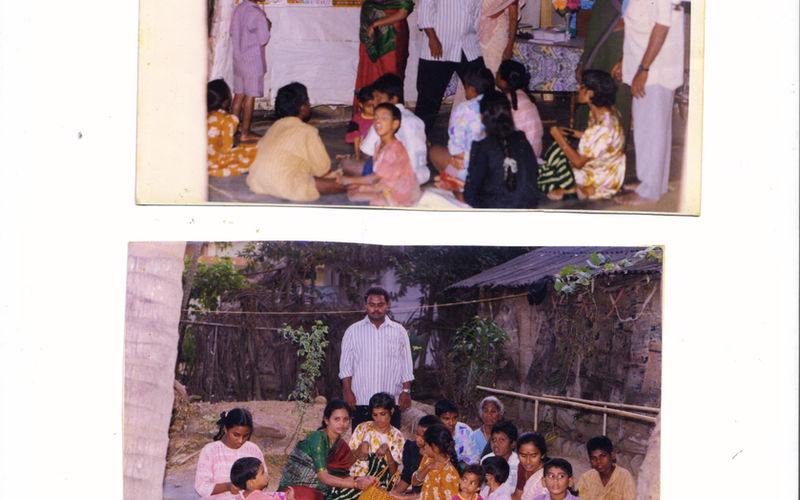
AshaJyothi began with one father's grief, ten children, and a small house at Hanuman Junction. Twenty-seven years later it is a campus of 83 children — and the same people are still here.
"AshaJyothi was born from our family's own tragedy — the loss of my daughter BalaJyothi, who suffered from mental illness. I honour her memory by saving children with special needs."
In 1998 we opened a small home at Hanuman Junction for ten abandoned children. In 2005, with sponsors Care n Share, we moved into our own building — beds, kitchen, school, paramedical support, 24/7 nursing. In 2016 the PARI unit began, bringing menstrual hygiene to every girl.
We work with children who are physically challenged, speech and hearing impaired, autistic, Down syndrome, or blind — children who often cannot walk, eat, or bathe on their own. All of them were either abandoned or orphaned at an incredibly young age.
Our mission is only to see smiles on these children's faces — and that those smiles sustain for a lifetime.
Shelter, food, hygiene, safety — the basics that should never have been negotiable.
24/7 nursing, physiotherapy, regular medical camps, and Neurogen treatments for severe cases.
Schooling and vocational training so that, where possible, our children can build a life beyond us.
The history of AshaJyothi, in three moments — with many more still being written.

A family's grief, turned into protection. AshaJyothi opens at Hanuman Junction with the first ten children.

With sponsor Care n Share, we move into our own premises — beds, kitchen, toilets, school, healthcare.

Menstrual hygiene management on campus. Dignity for every girl, quietly, ever since.
Five conditions account for almost every child at AshaJyothi. We explain them as a doctor would — without softening.
A non-progressive disorder caused by brain damage around birth. Severity ranges from mild physical to severe with intellectual involvement and seizures.
→ ii.Impaired social interaction, verbal & non-verbal communication, and restricted, repetitive behaviour.
→ iii.Difficulty with self-care, communication, social skills, academics. Classified mild to profound.
→ iv.A genetic condition caused by an extra copy of chromosome 21. Delayed growth, affected cognitive function.
→ v.Polio, accidents, neurological conditions that limit basic movement and independence.
→